



Mindfulness is not simply something that is gaining traction as the new “water cooler zen” for the workplace and beyond. Mindfulness is also gaining traction as an important “secret weapon” during traumatic brain injury recovery (TBI).
On February 19, 2016, my youngest daughter sustained a TBI while traveling in Colombia, South America. She was struck by a falling boulder and almost killed. Miraculously, against all odds, she survived. Within days, my daughter was flown to Jackson Memorial in Miami where the miracles continued. Eventually, when Schuy was considered stable, she was officially released from the hospital and into the care of Ryder Rehab.

Understand that when she was discharged, she could not sit. She most definitely could not be placed into a standing position without experiencing nausea. She could not speak. She had a feeding tube and could not eat. She was alive but most certainly not what anyone would ever consider “back on her feet”.
Insurance covered literally 4 weeks of in-patient rehabilitation and then regardless of her condition at that time, she had to be discharged and continue her treatment in the more limited capacity of outpatient care.
I can share with you the feeling of terror and overwhelment when I first brought Schuyler back to the apartment that we temporarily called “home”. We technically lived in Tampa, but Schuy’s injury had been so severe that we were advised to remain in Miami for a couple more months of our-patient treatment.
Becoming a “caregiver” can feel quite formidable. Every detail is new and complex. Suddenly, there are the details of handicap parking— how to open a heavy door and push Schuy through it without sobbing. Early in the process, bed sheets require changing multiple times a day— which means constant laundry. There is food to be prepared. There are meals to be spoon fed. There is the stress of physically moving my dear sweet child without falling. I remember it all too well.
How easy it would have been to simply cave in and tumble into a huge sense of frustration and despair.

Fortunately, Schuyler and I have both been avid believers in the power of positivity and in the healing momentum of mindfulness. This mindfulness and positive “expectation” is what carried me from that fateful Friday when I got “the call” through months in the ICU and finally into recovery. This mindfulness made the difference between finding reasons to laugh and to celebrate daily or losing that power to thoughts of negativity.
It didn’t take long to see how critical the mindset of both caregivers and patients is to the recovery from the TBI. Managing expectations and trusting the healing process are essential. The patients who find ways to smile and to believe that they will “get there” are typically the ones who “get there” the fastest. Finding ways to entertain the mind and to adapt to the new normal (even when that new normal is temporary) are important.
We searched out adaptive beaches and aqua therapy in Miami. When we returned to Tampa to continue her rehab, we added adaptive yoga into the mix. We stumbled upon a wonderful non-profit organization that specializes in TBI recovery specifically through yoga and meditation. Our Tampa instructor just recently became certified with this organization.
Love Your Brain is a non-profit organization created by former professional snow boarder Kevin Pearce in 2012 after he sustained a severe traumatic brain injury during practice two years earlier. Kevin, his brother and sister-in-law launched this organization to help TBI survivors lead lifestyles conducive to healthy brains through yoga, meditation and mindfulness. This program is even helpful to patients who have technically been discharged from outpatient therapy but who are still transitioning into maximum recovery.

An article recently in THE DARTMOUTH mentioned the following, “We’ve known for a long time that with moderate-to-severe traumatic brain injury, you need to start rehab immediately, but what’s different for mild traumatic brain injury or concussion is that people originally [think] you should rest instead of rehab,” professor of psychiatry and director of pediatric neuropsychological services at the Geisel School of Medicine Jonathan Lichtenstein added. “But more of modern research is leaning now to be more active when you recovery … I think this could play a role into that.”
The article goes on to say: Kyla Pearce was also interested in how to assess the quality of life reported by those affected by brain injuries. LoveYourBrain analyzed feedback from participants before and after yoga intervention and found overall participants reported that their quality of life increased. After the yoga class, participants wanted to continue to talk and connect with one another, so Kyla Pearce and her team developed more opportunities for relationship development.
“It’s been incredible to see that it is in a lot of ways really building a community,” Pearce said. “One thing that was really shocking is that there were people who said they had never met another person with a traumatic brain injury, even if they had been living with their own for multiple years.”
With the added discussion component, Pearce and her team have found people use the classes as an opportunity to mentor each other, share resources and be advocates for each other’s healing.
Schuyler and I have found that there is indeed a camaraderie among TBI patients and their families. There are many who epitomize the most uplifting, unconditional expressions of love. There is laughter. There is hope. There are many, many hugs and words of mutual encouragement. There is appreciation and respect. And, yes, there is mindfulness— truly living the moment. Taking one step… then the next… learning to laugh even at the stumbles.
I would never wish this sort of traumatic experience on anyone and yet, I can tell you through my own experience that mindfulness helped us not simply with Schuyler’s recovery. Undeniably, it has. The “magic” of mindfulness in our story is how mindfulness helped us see that trauma has the potential to bring out the best in people. As I share in my own web site www.ilovemyimpossible.com , it is not in spite of our boulders that we succeed. It is sometimes THANKS TO these boulders that we realize how to actually thrive.
Written by Meridith Hankenson Alexander www.ilovemyimpossible.com
To Read the Entire Love Your Brain article in THE DARTMOUTH, visit http://www.thedartmouth.com/article/2017/02/loveyourbrain-offers-rehabilitative-yoga-in-lebanon

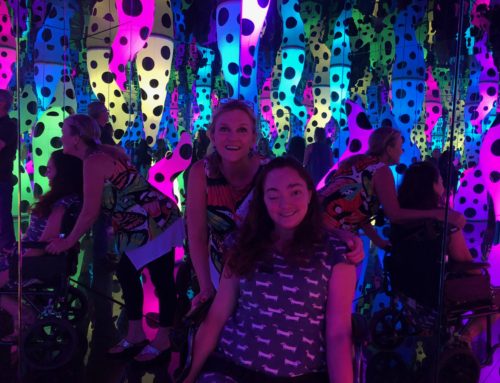
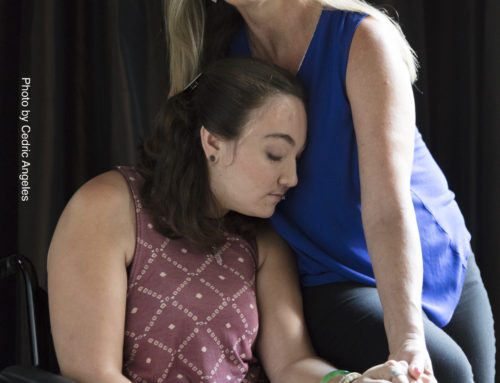
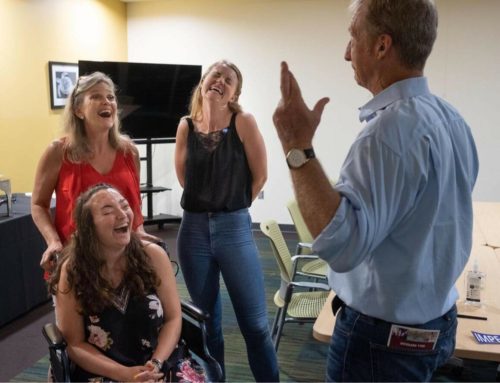



Beautiful Meredith! Love seeing these pics of our beautiful Schuy!
Yes, she is doing fabulously!
Thank you, Carol! I have found over the years that the topics that I think positively about tend to thrive. Those that I have more of a challenge with take longer to progress. There is definitely a correlation between the two. If we can discipline ourselves to think more intentionally and to encourage more of those supportive thoughts, our “luck” also starts to change! Thanks for following our story! Wishing you much joy!
Thank you for shining a spot light on TBIs! Society needs so much more brain research and understanding of the recovery process.
Thank YOU, Vicki! Yes, none of us who find ourselves in these situations typically have any training. We are asked to become unexpected heroes. If Schuy and my experiences can help others then it is a gift indeed!